
When Video Games Stop Being Games
Ukraine’s Experiment in Incentives, Drones, and Survival

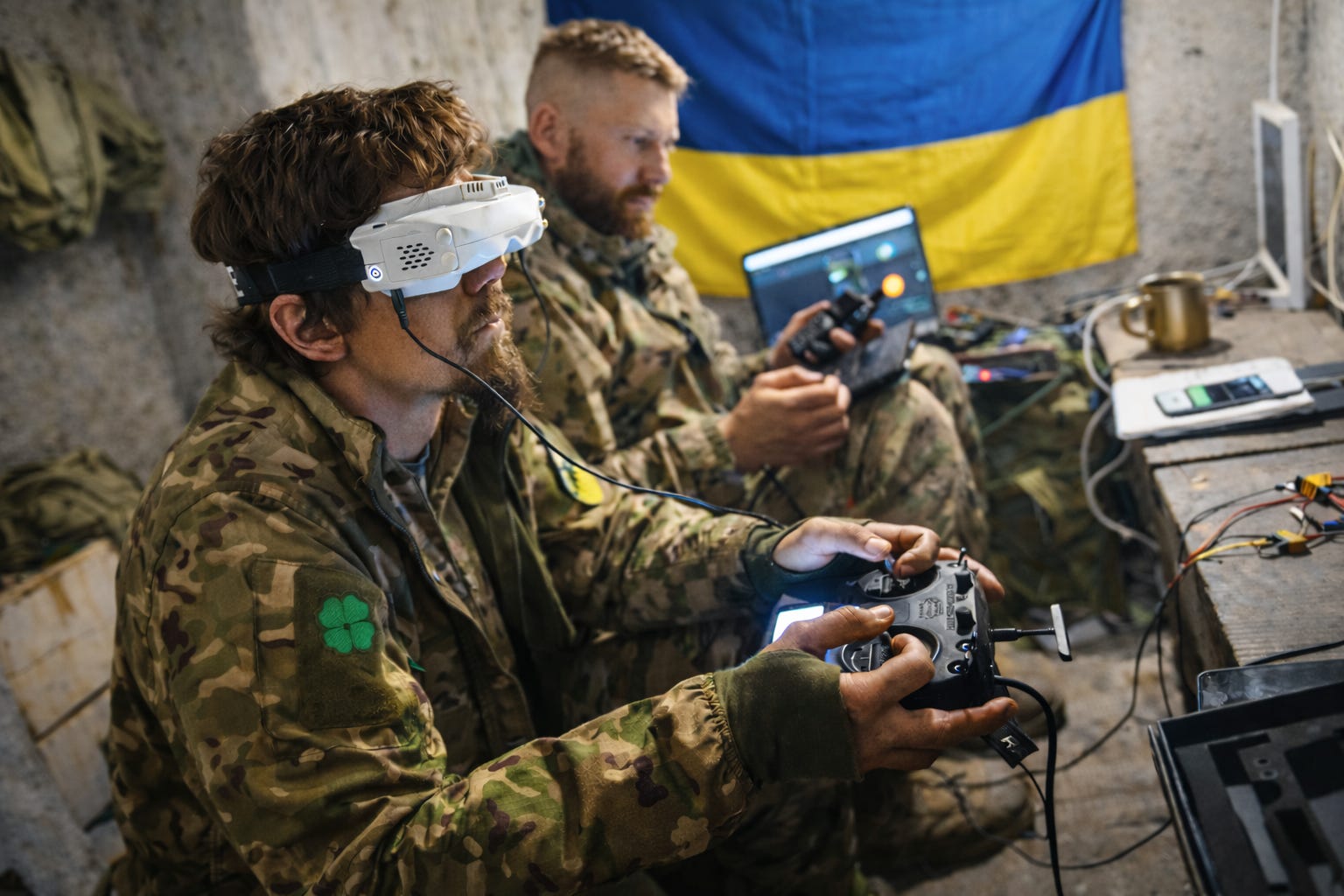
For decades, video games have been accused of encouraging detachment from reality. Too much screen time. Too little seriousness. At best, a distraction; at worst, a liability. War, we were told, was the domain of discipline, hierarchy, and experience forged far away from keyboards and controllers.
Ukraine’s war against Russia is quietly dismantling that assumption.
Not because war has become a game—it has not—but because some of the systems that games perfected over the last thirty years turn out to be brutally effective when survival depends on speed, feedback, and adaptation. In a conflict defined by drones, sensors, and constant visibility, Ukraine has begun borrowing ideas from an unlikely source: the mechanics of gaming itself.
This isn’t about novelty. It’s about necessity. When a smaller country faces a larger aggressor with more manpower and more inherited stockpiles, it doesn’t win by doing the same things slightly better. It survives by changing the rules faster than the enemy can follow.
What sounds abstract becomes concrete when you hear it explained by someone inside the war.
A Voice from Inside the War
Denys Davydov has become one of the more consistent Ukrainian voices explaining how the war is actually being fought. Not from press releases or polished briefings, but from the level where systems meet people. His January 25, 2026 report laid out something that initially sounds implausible and then, unsettlingly, logical.
Ukraine, he explained, has introduced a performance-based incentive system for drone operators. Soldiers earn electronic points—“E-points”—for confirmed battlefield results. Infantry targets, armored vehicles, artillery systems: each carries a value. Those points are not symbolic. They can be exchanged for drones, equipment, and mission-specific tools through a centralized digital platform that functions less like a military depot and more like an online store.
It sounds strange until you realize what problem it solves.
Why Ukraine Was Ready to Change
Ukraine did not arrive at this approach accidentally. Long before the full-scale invasion, the country invested heavily in digital governance. Entire layers of bureaucracy were collapsed into smartphone applications. Licenses, taxes, records, benefits—all moved into systems that reduced friction and, critically, reduced opportunities for corruption.
That mindset did not disappear when the war began.
The new defense leadership brought with it the same instinct: remove unnecessary intermediaries, shorten feedback loops, and let data replace guesswork. This matters in war more than in any other domain. Paper reports, delayed confirmations, and opaque chains of command cost time. Time costs lives.
A smaller force cannot afford ornamental process. It needs systems that reward what works, expose what doesn’t, and adapt continuously. In that sense, Ukraine began to resemble a startup not because it wanted to, but because the alternative was extinction.
Turning Performance into Resources
The E-points system is simple in concept and uncomfortable in implication.
Confirmed battlefield results generate points. Points translate into access. Units with higher effectiveness gain priority in acquiring better drones and specialized equipment. The mechanism is automated, tracked digitally, and tied directly to outcomes rather than rank or proximity to command.
There is no attempt to dress this up as something it isn’t. War already measures success in destruction; this system merely aligns resource allocation with demonstrated impact. It replaces subjective lobbying with transparent metrics.
The “Brave One” platform—described by Davydov as functionally similar to Amazon—allows units to select what they need based on mission profiles. The defense ministry procures directly from developers and routes equipment accordingly. For now, the system focuses on drones, but it is expanding.
What makes this effective is not the points themselves. It’s what they replace: static distribution, favoritism, and the illusion that all units are equally positioned to deliver results at all times. They aren’t. Pretending otherwise is how resources get wasted.
The Skills War Didn’t Have to Teach
One of the more striking observations Davydov made was almost incidental: many of Ukraine’s most effective drone operators were gamers long before they were soldiers.
This is not romanticism. It’s physiology.
Modern drones are controlled through interfaces that reward fine motor control, spatial awareness, and rapid decision-making under pressure. Gamers have spent years training exactly those skills. Muscle memory matters. Comfort with controllers matters. The ability to process multiple inputs simultaneously matters.
Teaching these from scratch takes time Ukraine does not have. Leveraging existing skill sets is simply efficient. In a war defined by learning curves, shortening the curve is decisive.
What once looked like frivolous familiarity with virtual systems now translates into real-world advantage. Not because games predicted war, but because both environments reward the same cognitive traits.
Competition Without Fragmentation
The idea that better units receive better equipment raises obvious concerns. Doesn’t this create inequality? Doesn’t it undermine cohesion?
In practice, it does the opposite.
All Ukrainian units face the same enemy. When high-performing units receive superior tools, their success benefits everyone. Enemy capabilities are reduced. Pressure is redistributed. Time is bought.
This is a competitive system without a zero-sum internal game. Units are not competing against each other; they are competing against the problem in front of them. The incentives align upward.
Davydov’s comparison to gaming is instructive here. In multiplayer games, teams benefit when the most skilled players are properly equipped. The objective isn’t fairness—it’s winning the match. In Ukraine’s case, the match is survival.
Russia’s approach offers a sharp contrast. Elite drone units exist, but they are tightly controlled by senior commanders operating within rigid hierarchies. Supplies and orders flow downward slowly. Feedback flows upward imperfectly, if at all. The system rewards conformity more than effectiveness.
Fighting With Fewer Bodies
The most important outcome of this shift is not efficiency. It’s fewer Ukrainian deaths.
Drones and ground unmanned vehicles are increasingly used for tasks that once required exposing soldiers to direct fire. Evacuation, resupply, reconnaissance, even limited fire support—machines now do what humans used to do under extreme risk.
Davydov described cases where unmanned ground vehicles evacuated wounded soldiers under drone attack and returned them alive. These are not abstractions. They are individual lives preserved because systems favored adaptation over tradition.
Ukraine still needs infantry. No one inside the war pretends otherwise. But the role of infantry is changing. Trenches are no longer safe by default. Visibility is constant. Exposure is punished instantly. Technology that reduces the need to occupy predictable positions saves lives.
That, ultimately, is the moral center of this story.
The Cost of Refusing to Adapt
Russia’s problem is not a lack of equipment or manpower. It is inertia.
Command structures built for wars of the past struggle to process wars of the present. Information degrades as it moves upward. Bad news is filtered. Success is exaggerated. Decisions are made on distorted inputs.
Ukraine’s digitized systems are designed to make lying harder. When drone footage, engagement data, and unit activity are logged automatically, reality becomes difficult to suppress. Corruption becomes harder to hide. Failure becomes visible.
None of this guarantees victory. It simply improves the odds.
In war, refusing to adapt is not neutral. It is a decision—with consequences that accumulate quietly and then all at once.
What This War Is Quietly Teaching
There is something unsettling about learning lessons from war. No one asked for this laboratory. No one volunteered for the experiment.
And yet, here it is.
This conflict is demonstrating that future wars will be shaped less by sheer numbers and more by systems that reward learning, expose truth, and move resources toward effectiveness without delay. Interfaces matter. Incentives matter. Feedback matters.
Ukraine did not choose to become this kind of army. It was forced to. That distinction matters.
Watch This Before You Look Away
If this sounds improbable, I’d urge you to hear it explained directly by Denys Davydov. His January 25, 2026 video lays out the mechanics, the logic, and the stakes far more concretely than any summary can.
Understanding how Ukraine is fighting is not about fascination with technology. It’s about recognizing adaptation when it happens—and noticing who is willing to change, and who is not.
In wars like this, attention is not passive. It is part of the equation.