
Natural Language Programming at Scale
Why the Next Creator Economy Will Eclipse Legacy Software Development


For decades, software creation has been constrained by the scarcity of people fluent in formal programming languages such as Python, JavaScript, Java, and C++. Today, that constraint is breaking.
Natural Language Programming (NLPg), the ability to create computational artifacts using human language through generative AI platforms, has expanded the base of solution creation from tens of millions of professional developers to hundreds of millions, and potentially billions, of capable creators.
In this piece, I advance three core claims:
Natural language has become a programming interface, dramatically lowering the barrier to creation.
The population of people capable of creating reusable agents, assistants, and workflows now rivals—and may exceed—the population of professional software developers.
The limiting factor is no longer access or creativity, but reliability. Without engineering discipline, NLPg produces fragile, non‑deterministic, and ungovernable outcomes. This is the central problem The Fusion Syndicate exists to solve.
From Programming Scarcity to Language Abundance
The global software industry has long been shaped by a hard constraint: only a small fraction of the population can reliably write code.
Total global developers (all types): ~47–50 million
Professional software developers (coding as a primary job): ~27–36 million
Even at its peak, formal programming literacy never exceeded a few percent of the global workforce.
Generative AI changes this constraint fundamentally. Platforms such as ChatGPT, Microsoft Copilot, Claude, and Gemini allow users to express intent, logic, constraints, and workflows directly in human language—and have those instructions executed computationally.
Language, not syntax, becomes the interface.
A New Way to Count Creators
Traditional labor statistics fail to capture this shift because they count jobs, not capabilities.
To understand NLPg, we must reframe the question: How many people can now create reusable computational artifacts for others using natural language?
ChatGPT alone reports roughly 1 billion monthly users. Even under conservative assumptions:
If 80–85% are consumers only
10–15% are light creators (templates, shared prompts, assistants)
1–3% are heavy creators (reusable agents and workflows for others)
That implies 10–30 million NLPg creators on ChatGPT alone.
When enterprise skewed platforms like Microsoft Copilot are added—where agent creation is explicitly supported and governed—the global NLPg creator population plausibly reaches‑ 30–60 million people today.
This is already comparable to, and potentially larger than, the professional software developer population.
And unlike legacy programming, this population is still expanding rapidly.
Why This Is an Order-of‑Magnitude Shift
Natural Language Programming does not merely increase productivity—it changes the base of who can create solutions.
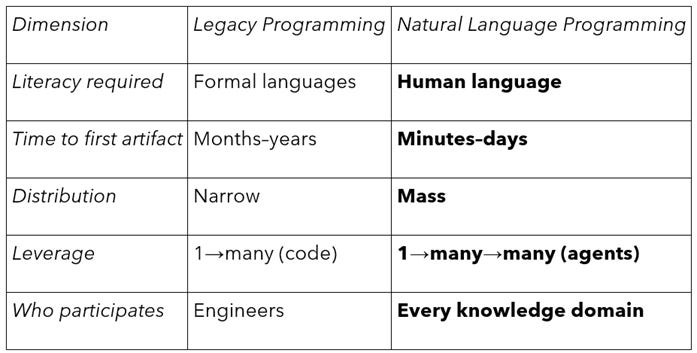
This mirrors prior abstraction breakthroughs:
Excel vs. C++
PowerPoint vs. PostScript
SQL analysts vs. database engine developers
In every case, the number of creators exploded, without eliminating professionals. The center of leverage moved.
The Reliability Problem
Despite its promise, NLPg today suffers from a critical flaw: “Vibe coding” does not scale to business critical‑ solutions.
Common failure modes include:
Hallucinated facts and sources
Scope drift and role confusion
Non‑deterministic behavior
Hidden contradictions between instructions
False confidence about tool or file access
These are not model problems. They are design problems.
When natural language becomes executable, it must be treated with the same rigor as software.
Prompts as Code: Engineering Discipline for NLPg
As CTO of The Fusion Syndicate, my core insight is simple: If natural language can create software like‑ behavior, it must be engineered like software.
This led to the Fusion™ AI Agent Development Lifecycle: Build → Reinforce → Debug
Build: Define role, output contract, scope, constraints, epistemic stance, grounding plan, and deterministic workflow before execution.
Reinforce: Harden agents with minimal shims and guardrails targeting known failure modes.
Debug: Treat failures as reproducible bugs—localize root cause, patch narrowly, and add regression protection.
This lifecycle converts ad hoc‑ prompting into maintainable, auditable, production grade‑ systems—without requiring users to become traditional programmers.
Why This Matters Now
The economic question is no longer: Will AI replace software developers?
The real question is: Who will enable the next hundred million creators to build reliable solutions?
Organizations that fail to impose structure on NLPg will see:
Silent errors
Compliance failures
Governance breakdowns
Loss of trust in AI systems
Organizations that succeed will unlock a massive expansion of the solution creator‑ ecosystem, multiplying both users and value creation.
Natural Language Programming represents the largest expansion of computational authorship in history.
The creator base is already comparable to professional software development.
It will soon exceed it by multiples.
Reliability, not access, is now the binding constraint.
The future of programming is not fewer programmers. It is more creators—properly equipped.
Appendix: Market Sizing, Math, and Sources
These are the quantitative assumptions used in this piece. Where primary vendors do not publish exact figures, ranges are used and clearly labeled as estimates.
Baseline: Professional Software Developers (”Legacy Programmers”)
Definition used: Individuals whose primary occupation involves writing software using formal programming languages (e.g., Python, JavaScript, Java, C++).
Authoritative estimates:
Evans Data Corporation estimates 26.9 million professional developers globally, projecting growth past 30 million by 2025.
Source summary: Evans Data is a longstanding developer‑ economics research firm frequently‑ cited by Microsoft, IBM, and Intel.
URL: https://distantjob.com/blog/how-many-developers-are-in-the-world/
Slash Data (2025) estimates 47.2 million total developers, of which ~36.5 million are professional developers, and the remainder are amateurs or learners.
Statista (2024–2025) places the global employed software developer population at ~28.7 million, excluding many freelancers.
Working range used in this paper:
Professional software developers worldwide: ~27–36 million
This aligns the conservative (Statista) and expansive (Slash Data/Evans Data) views.
Natural Language Programming Platforms: User Scale
Natural Language Programming (NLPg) is enabled by access to generative AI‑ platforms with conversational interfaces capable of producing reusable computational artifacts.
ChatGPT (OpenAI)
~800 million weekly active users reported as of late 2025
Multiple independent analyses place monthly active users near or approaching 1 billion
Sources:
CNET: “ChatGPT Has Almost 1 Billion Weekly Users” (Feb 2026)
Demand Sage (compiled from Reuters, Similar Web, Axios):
Key caveat: OpenAI does not publish a single definitive MAU number; estimates converge between 700M–1B users.
Google Gemini
~750 million monthly active users disclosed in Alphabet Q4 2025 earnings
Gemini is embedded into Google Search, Workspace, and Android surfaces
Sources:
TechCrunch: “Google’s Gemini app has surpassed 750M monthly active users” (Feb 2026)
Demand Sage Gemini statistics:
Microsoft Copilot
~200+ million users across Windows, Microsoft 365, web, and mobile surfaces (2025–2026 estimates)
Enterprise adoption is disproportionately high relative to consumer AI tools
Sources:
Business of Apps: Microsoft Copilot Usage Statistics (Jan 2026)
Microsoft Learn: Copilot Analytics & Agent Dashboard documentation
Claude (Anthropic)
Anthropic does not publish total MAU figures
Claude shows high enterprise usage intensity, particularly in regulated industries and professional services
Sources:
Anthropic Enterprise overview:
VentureBeat: “Anthropic says Claude Code transformed programming” (Feb 2026)
Creator Distribution Assumptions
A capability-‑based creator model, not a labor ‑title model.
Empirical creator ecosystems (GitHub, Excel macros, YouTube, Wikipedia) consistently follow a power law‑ distribution:
~80–85% consumers only
~10–15% light creators (templates, shared artifacts)
~1–3% heavy creators (reusable systems for others)
These ratios are supported by:
Anthropic research on AI usage concentration
Microsoft Copilot telemetry distinguishing users vs. agent creators
NLPg Market Sizing Math (Illustrative)
Using ChatGPT alone as a conservative anchor:
1,000,000,000 monthly users (rounded)
1–3% heavy creators ⇒ 10–30 million NLPg creators producing artifacts for others
Adding additional ecosystems (with overlap assumed):
Copilot (enterprise heavy‑ creators): +3–10 million
Gemini / Claude incremental creators: +2–5 million
Resulting global estimate:
Natural Language Programmers creating for others: ~30–60 million people
Interpretation Boundary
These figures do not claim:
That NLPg replaces software engineers
That all creators are professionals
That all outputs are production grad‑e
They do demonstrate:
The capability base for creating executable logic via language now rivals or exceeds traditional programming
Reliability, not access, is the dominant constraint
This is the economic basis for treating Natural Language Programming as a new creation layer—not merely a productivity feature.